Andalusite Visible Spectra (380 - 1100 nm)
Andalusite, Al2(SiO4)O, obtains a greenish yellow color from Fe3+.
If Mn3+
is in the structure, a dark
green color results. The intense
brownish-red
color commonly observed for light polarized in the c direction is the result of
strong absorption from the Fe2+
- Ti4+
intervalence
charge transfer centered near 480 nm. Many samples contain an admixture
of colors from Fe, Ti and Mn. Varieties containing vanadium [V3+]
and chromium are known which have reddish-brown colors.
Images of the andalusite absorption spectrum
- GRR
278 spectrum;
from
Santa Teresa district, Espírito Santo, Brazil. 0.912 mm thick
sample. The color of
andalusite from this locality
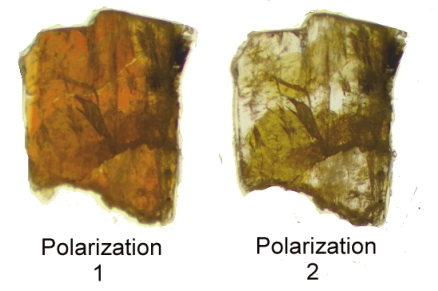
varies considerably with the direction in which it is observed. It
varies
from yellowish green to a hard-to-describe blend of red and green. Data
Files: E||a; E||c;
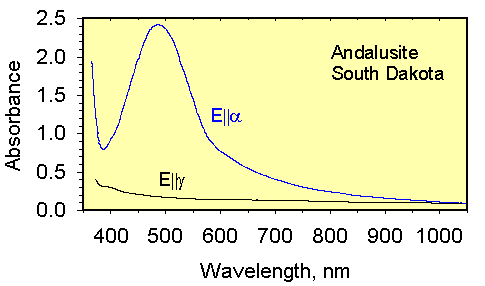
- GRR
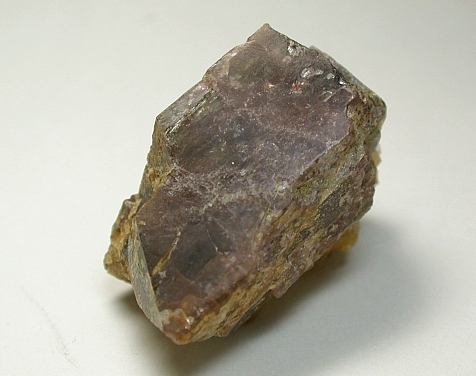
375 spectrum;
a lavender crystal
from Tenderfoot Mountain, near Custer, South Dakota, USA. 0.951
mm thick sample. Data files: E||a;
E||c;
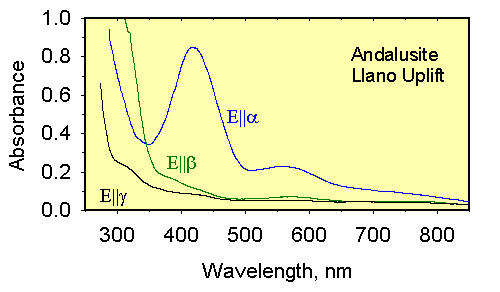
- GRR 3467 spectrum;
The
core region of a reddish brown crystal from the Llano uplift, Texas,
USA
which contain about 0.81 wt% vanadium (expressed as V2O3)
and about 0.09 wt% chromium. Presented for a 0.110 mm thick sample.
Data
files: alpha
= E||c; beta
= E||b; gamma = E||a.
- CIT 17228
spectrum; An orange-brown
crystal from Itanga, Minas Gerais, Brazil; 0.692 mm thick.
Not a centered optical figure. Data files: light,
dark
- MT-Brazil;
Color zoned crystal
from Brazil. 0.79 mm thick crystal with all data normalized to 1.0 cm.
The crystal contains 0.35 wt% FeO and a trace amount of titanium. Note
the difference in the intensity of the Fe-Ti intervalance charge
transfer band near 480 nm between the spectrum of
the light zone and spectrum of the
dark zone. Data Files: Contributed data from
Michail Taran, Kyiv, Ukraine: light zone: E\\a, E\\b, E\\c.
Dark zone: E\\a,
E\\b,
E\\c.
Manganese-containing
andalusite (variety viridine)
- GRR
305 spectrum,
from Minas Gerais, Brazil. 0.258 mm thick sample containing MnO that
varies from 1.06 to 1.72 wt% (average 1.41) and FeO that varies from
0.59 to 0.76 wt% (average 0.69). This sample has an apple green color
from Mn3+. Data
files: alpha
= E||c; beta
= E||b; gamma
= E||a.
Link to a collection
of references to mostly color and visible spectroscopy of
andalusite.
 Back
to the list of minerals
Back
to the list of minerals
 Back
to the Index of Data Files
Back
to the Index of Data Files
 Back
to the
Mineral Spectroscopy home page
Back
to the
Mineral Spectroscopy home page
revised 5-Jul-2022