Tourmaline colors
The color of tourmaline
originates from the metal ions (Fe,
Mn, Cr, V, Ti, Cu) in its structure. Colors come both from light
absorption by the individual ions (eg, Fe2+
or Cr3+)
and by light absorbed by interactions between ions (eg, Fe2+-Ti4+,
Mn2+-Ti4+
or Fe2+-Fe3+
intervalence charge transfer [IVCT]).
Blue color is usually caused by
Fe2+
but can also
come from Cu2+
in rare Brazilian elbaites.
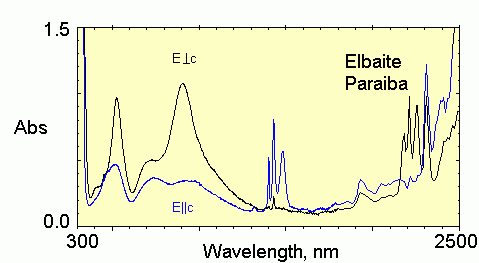
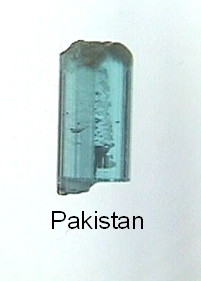
[Blue iron-containing elbaite from Pakistan.] [The spectrum of blue copper-containing elbaite from Paraiba State, Brazil.
Green color comes from either Fe2+-Ti4+
IVCT
together with Fe2+,
or from either Cr3+
or V3+
alone, or in combination.
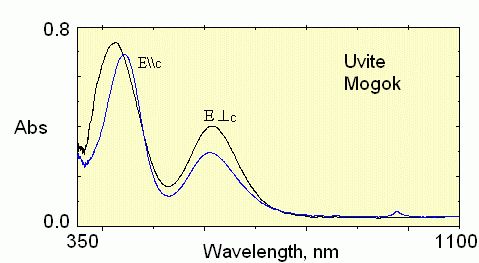
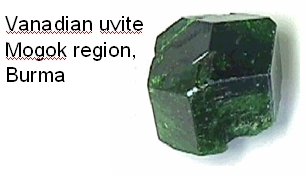
[Uvite from the Mogok region of Myanmar containing mostly V and some Cr]
Amber to orange-brown colors
(often seen in dravites) come
from Fe2+-Ti4+
alone.
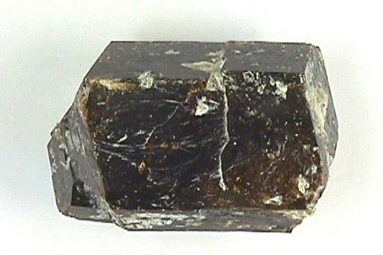
[Dravite from Yinietharra, Western Austrailia, dominated by color derived from the Fe2+-Ti4+ interaction.]
Yellow to yellow-brown colors
result from Mn2+-Ti4+
IVCT.
[Elbaite from the Hyakule Mine, Nepal, displaying colors from interactions with titanium with Mn2+-Ti4+
IVCT and Fe2+-Ti4+
IVCT in different zones].
A greenish yellow to yellow color is from
Mn2+ plus Mn2+-Ti4+
IVCT.
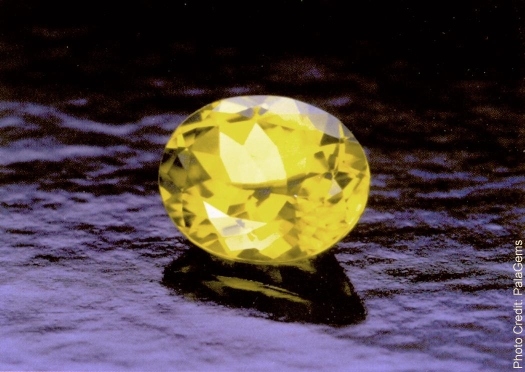
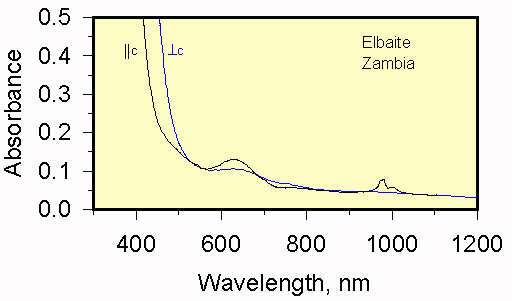
[Faceted 'canary tourmaline' from Zambia]. [Mn-elbaite
spectrum].
Pink and red colors are from Mn3+.
The color of
pink manganese-containing tourmalines often is associated with
exposure to ionizing radiation (such as from the decay of 40K,
a common constituent of pegmatites).
Black tourmalines (schorls,
etc.) are dark because of
their high concentrations of iron, manganese and titanium. When
they are ground very thin, they are usually blue or
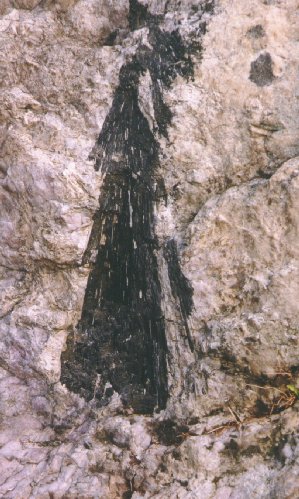
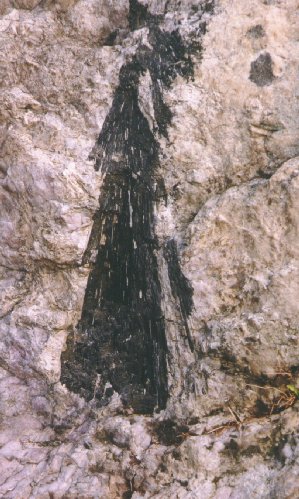
brownish-green. [60 cm cluster of schorl from the
Czech Republic]. [schorl
spectrum].
Many tourmalines owe their
color to a mixture of metal ions.
The great diversity of color in tourmalines is due the the
variability in which these mixtures occur.
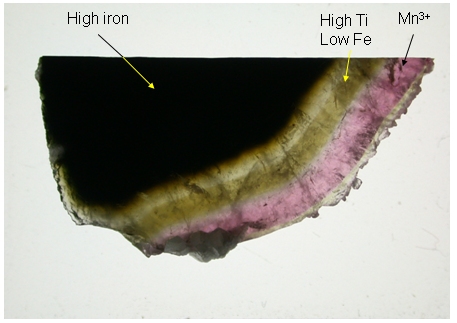
[A slice of tourmaline from the Himalaya Mine, San Diego County, California, showing different colors from different causes]
Images of Tourmaline Slices
For images of colorful
tourmaline slices and more information
about their color go to the section on tourmaline
slices .
Representative
tourmaline spectra
Visible Spectra: polarizations:
(a = incident light polarized
perpendicular to c-axis; c = parallel to c-axis)
Blue, green, brown and black
Fe-containing tourmalines
GRR
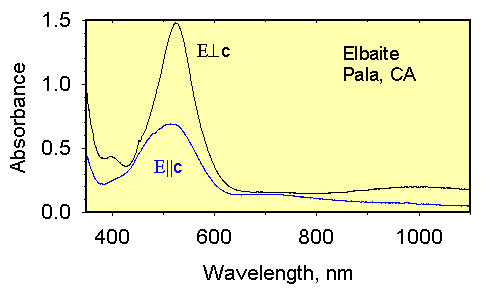
512 spectrum; Schorl, GRR 512, White Queen
Mine, Pala, California, 0.010 mm thick. Black in mass, blue when very
thin. Contains 13.5% "FeO" and 0.95% "MnO". Data Files: a; c ;
GRR
596 spectrum; Elbaite, GRR 596G,
Afghanistan, 0.25 mm thick. Dark green crystal colored by Fe2+
and Ti4+
- Fe2+
interactions. Contains 4.32% "FeO", 1.67% "MnO" and 0.04% "TiO2".
Data Files: a ; c ;
GRR
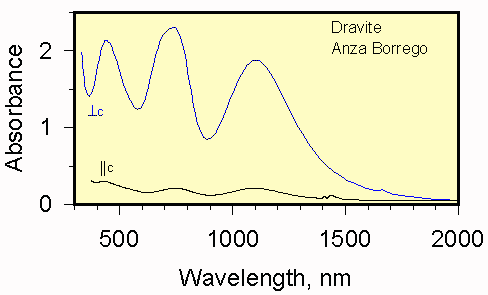
787 spectrum; Dravite, GRR 787,
Sweeney Canyon, Anza Borrego, California, USA, 0.10 mm thick. The black
crystal that most people would call schorl is green when thin. The
intense absorptions in the perpendicular to c direction at 730 and 1120
nm result from enhancement of Fe2+
bands caused by interactions with Fe3+.
The intense absorption in the same direction near 430 nm is from Fe2+
- Ti4+
intervalence charge transfer. The crystal contains 6.93% "FeO", 0.05%
"MnO" and 0.53% "TiO2".
Data Files: a
0K ; c 0K .
GRR
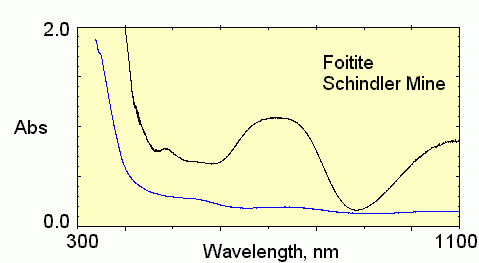
79 spectrum Foitite, GRR 794,
Schindler Mine, California, USA, 0.048 mm thick. Black crystal, blue
when thin. Data Files: a ;
c .
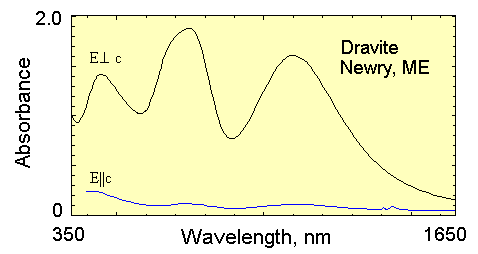
S3 spectrum,
Dravite, S3, Newry, Maine, USA. Brown to green, complexly
zoned. Spectra from a green zone. Contains Mg1.19
Fe1.16 Ti 0.04. Data files: a
0K ; c 0K .
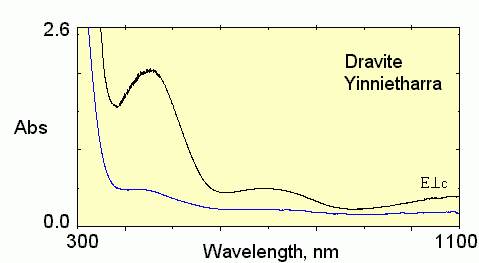
CIT 12683 spectrum,
Dravite, CIT 12683, Yinnietharra, Australia. Brown crystal, 0.680 mm
thick. The absorption band near 450 nm arising from Fe2+
- Ti4+
intervalence charge transfer is the primary cause of the color of this
crystal. Data files: a ; c .
GRR
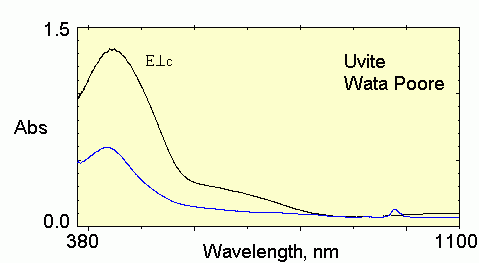
2098 spectrum; Uvite, GRR 2098, Wata
Poore area, Konar Province, Afghanistan. 3.98 mm thick. Pale brown
crystal. The color is dominated by the Fe2+
- Ti4+
intervalance charge transfer arising from the minor amounts of both Fe
and Ti that are in this crystal. Data Files: a
0K ; c
0K .
S 8 spectrum;
Uvite, S 8, Pierrepont, New York, USA, NMNH 81511, 0.10 mm thick. Black
crystal. Contains 8.23% "FeO" and 0.55% "TiO2".
Data Files: a
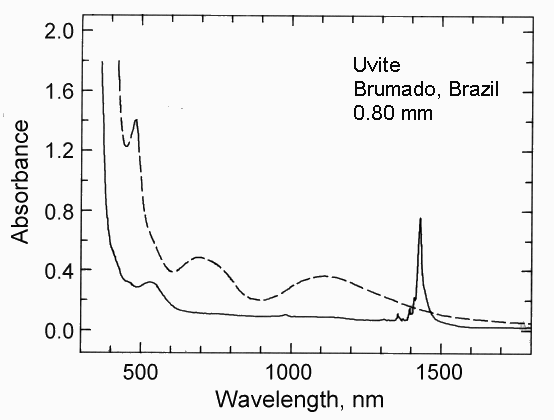
0K ; c 0K . GRR 244 spectrum; Uvite, Brumado, Bahia, Brazil. Plotted as 0.80 mm thick
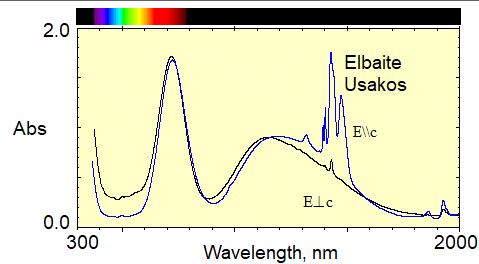
GRR 1935a spectrum;
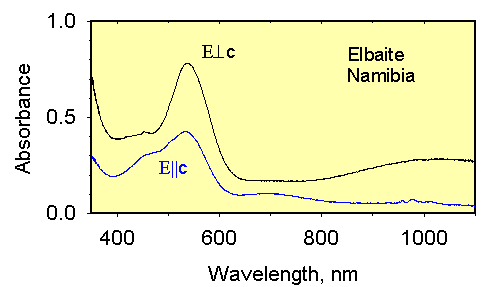
Elbaite from Usakos, Namibia, blue crystal. 3.641 mm thick. Data Files: a ; c .
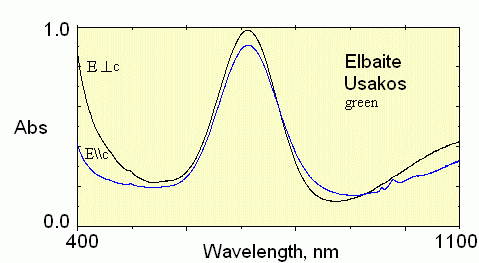
GRR 1935b spectrum;
Elbaite from Usakos, Namibia, green crystal, 3.654 mm thick. Data Files: a ; c .GRR 3770 spectrum; a pure blue  crystal, unknown locality. 2.00 mm thick. Data Files: a ; c .
Blue Cap Elbaite
Green V3+ and Cr3+ tourmalines
- GRR 2128 spectrum; green uvite with 0.049 wt% Cr2O3 and 0.614 wt% V2O3 from the Mogok region, Myanmar, plotted as 1 mm thick.
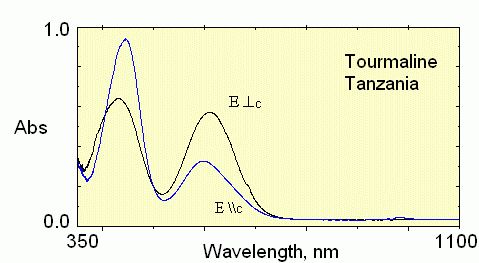
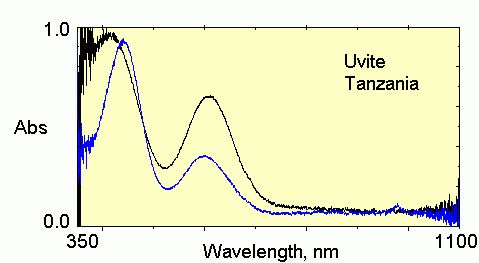
- GRR 2467 spectrum: yellow-green uvite with 0.140 wt% Cr2O3 and 0.044 wt% V2O3 from Tanzania, plotted as 1 mm thick.
- GRR 1719 spectrum: dark-green dravite with 0.199 wt% Cr2O3 and 0.452 wt% V2O3 from Tanzania, plotted as 1 mm thick.
- GRR 768 spectrum; dark-green fluor-rich uvite with 0.140 wt% Cr2O3 and 0.244 wt% V2O3 from Kenya, plotted as 1 mm thick.
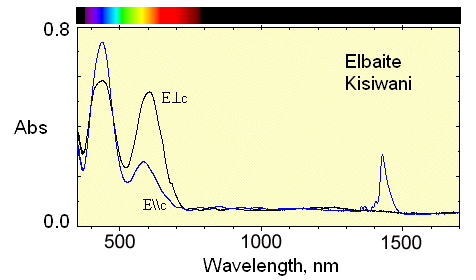
- GRR 3245;
Elbaite from Kisiwani village, Tanga Province, Tanzania, that shows
Usambara effect, 0.404 mm thick. This is part of the sample used by Taran et al.,
(2015) Mineralogical Journal (Ukraine) p12-21. Data Files: a ; c .
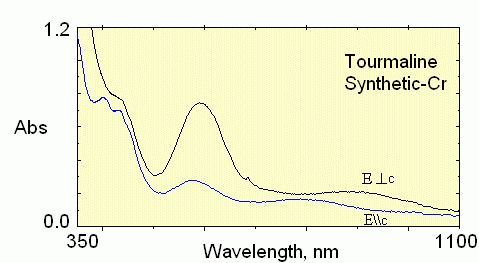
- Olenite spectrum; synthetic Cr-doped with 0.42 wt% Cr2O3 and no V2O3 plotted as 1 mm thick. Contributed data from Michael Taran, Kiev. See Taran et al (1993) Phys. Chem. Minerals 20: 209.
Cu2+
colored tourmalines
R030 spectrum;
Elbaite, São José da Batalha, Paraíba,
Brazil, 0.20 mm thick. Blue crystal colored by Cu2+.
Ref: Rossman et al. (1991) Amer. Mineral 76, 1479-1484. Data Files: a ; c .
Elbaite-MT spectrum;
Elbaite, São José da Batalha, Paraíba,
Brazil, 1.84 mm thick. Pink crystal colored by both manganese and copper. Data Files: a ; c . Contributed data from Michael Taran, Kiev.
Pink and yellow-green Mn-containing tourmalines
GRR
1368 spectrum; dark pink elbaite from
Otjimbinque, Namibia, 2.188 mm thick. The color  is from Mn3+
and represents one of the deeper colored natural pink tourmalines. Data Files: a ; c .
GRR
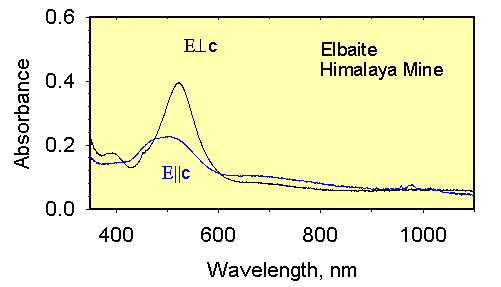
565 spectrum; light pink elbaite from the
Himalaya Mine, Mesa Grande, California. The color
is from Mn3+
and represents one of the deeper colored natural pink tourmalines. Data Files: a ; c .
GRR
565 spectrum; light pink elbaite from the
Himalaya Mine, Mesa Grande, California. The color  is natural color from
Mn3+.
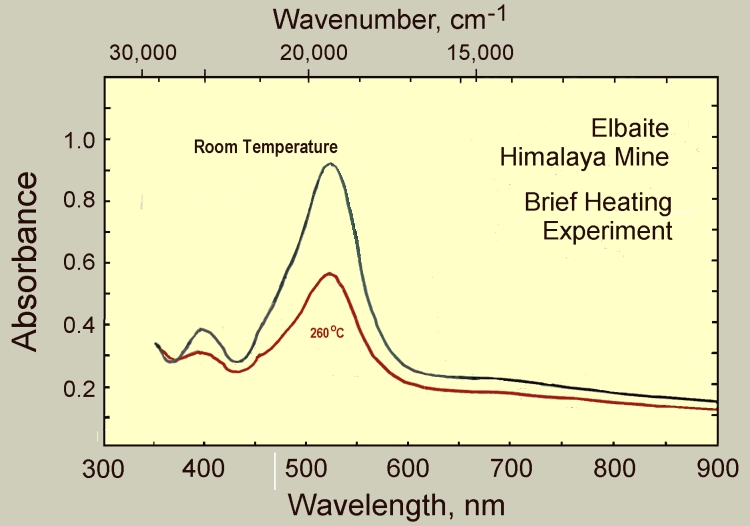
GRR
565 spectrum; dark pink elbaite from the
Himalaya Mine, Mesa Grande, California. This sample has been irradiated
with 60Co
gamma rays to enhance its color
is natural color from
Mn3+.
GRR
565 spectrum; dark pink elbaite from the
Himalaya Mine, Mesa Grande, California. This sample has been irradiated
with 60Co
gamma rays to enhance its color  . The color is from Mn3+
and represents a typical treated color for pink tourmalines. While stable at ambient temperatur, the some of the Mn3+ will be converted back to Mn2+ after brief, gentle heating. When heated to the temperature of initial crystallization, esentially all the pink color of Mn3+ is lost.
GRR 876 spectrum; heavily irradiated pink
elbaite from the Stewart Mine, Pala, California. Although the sample
has been treated, the color is from Mn3+
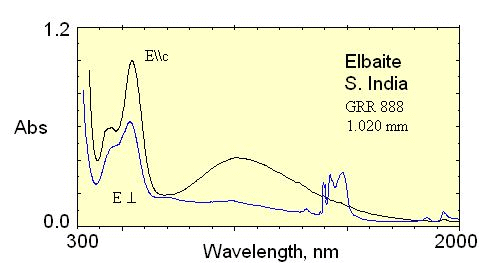
and resembles the color of natural pink tourmaline.GRR 888 spectrum; darker red olenite
. The color is from Mn3+
and represents a typical treated color for pink tourmalines. While stable at ambient temperatur, the some of the Mn3+ will be converted back to Mn2+ after brief, gentle heating. When heated to the temperature of initial crystallization, esentially all the pink color of Mn3+ is lost.
GRR 876 spectrum; heavily irradiated pink
elbaite from the Stewart Mine, Pala, California. Although the sample
has been treated, the color is from Mn3+
and resembles the color of natural pink tourmaline.GRR 888 spectrum; darker red olenite  from Khammam, Andhra Pradesh, India. Andreas Ertl provided data on site occupancies: X site = [Na 0.7, Ca 0.0, [] 0.3]
GRR
757 spectrum; Yellow-green elbaite,
from Khammam, Andhra Pradesh, India. Andreas Ertl provided data on site occupancies: X site = [Na 0.7, Ca 0.0, [] 0.3]
GRR
757 spectrum; Yellow-green elbaite,  Zambia, 2.00 mm thick, with high Mn2+
content and some Ti4+ that interacts with the Mn2+. Ref: Rossman & Mattson (1986) Amer. Mineral 71,
599-602. Data Files: a
0K ; c 0K ;
Elbaite soectrum;
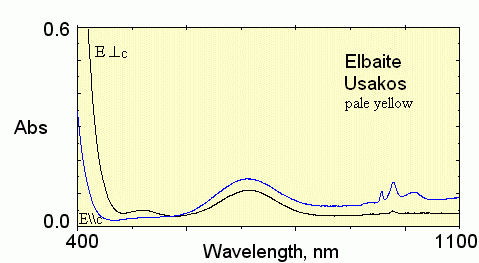
Usakos, Namibia, pale yellow crystal, 5.353 mm thick. Data Files: a ; c .
GRR
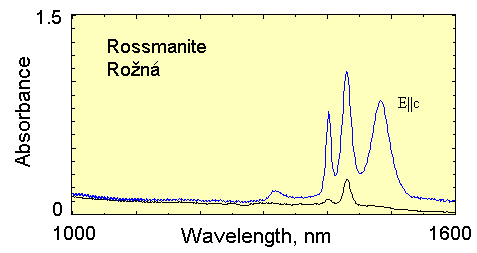
1932 spectrum; Pale
pink rossmanite, Rozná, Czech Republic, 2.976 mm thick. This is
a crystal of the type specimen. The color comes from the
radiation-induced Mn3+
content. Here is the NIR
OH
region;
of the same crystal. Data Files: a 0K
; c 0K ;
Zambia, 2.00 mm thick, with high Mn2+
content and some Ti4+ that interacts with the Mn2+. Ref: Rossman & Mattson (1986) Amer. Mineral 71,
599-602. Data Files: a
0K ; c 0K ;
Elbaite soectrum;
Usakos, Namibia, pale yellow crystal, 5.353 mm thick. Data Files: a ; c .
GRR
1932 spectrum; Pale
pink rossmanite, Rozná, Czech Republic, 2.976 mm thick. This is
a crystal of the type specimen. The color comes from the
radiation-induced Mn3+
content. Here is the NIR
OH
region;
of the same crystal. Data Files: a 0K
; c 0K ;
Red tourmaline with Fe
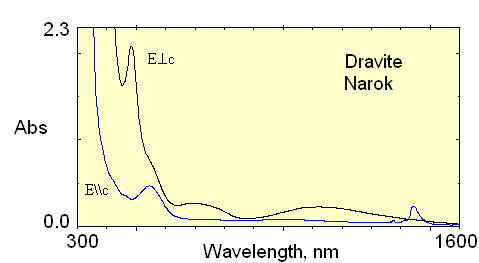
- GRR 228 spectrum; Red dravite
 from Narok, Kenya, plotted for 0.10 mm thick. Same sample with expanded NIR range. Composition: Na0.88Ca0.01Mg2.27Fe0.58Mn0.00Ti0.03Al6.12(BO3)3Si5.99O18(OH)4. See: Physics and Chemistry of Minerals 14, 225–234. Data Files: a ; c .
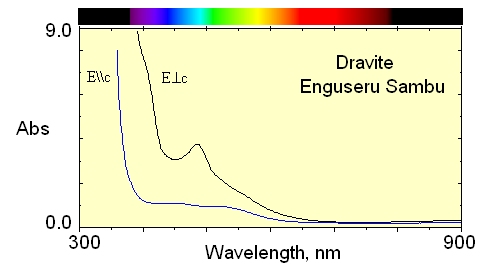
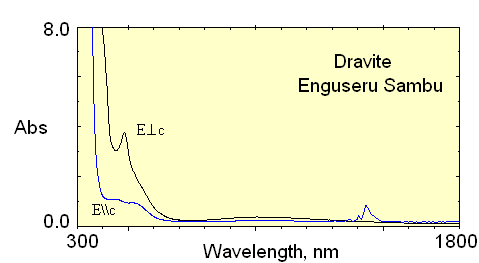
- MT Red dravite spectrum; from Engusero Sambu, Tanzania, plotted for 1.00 mm thick. Same sample with expanded NIR range. The color comes from Fe2+-Fe3+ interactions. Composition: Na0.66Ca0.16Mg2.62Fe0.33Mn0.02Ti0.02Al5.95(BO3)3Si6.04O18(OH)4. See: Physics and Chemistry of Minerals 42, 559-568. Data Files: a ; c . Contributed data from Michael Taran, Kiev.
Orange tourmaline
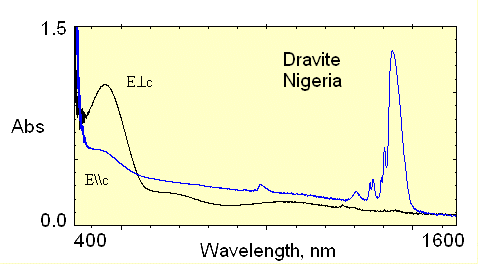
- GRR 1715 spectrum; orange dravite from Nigeria, plotted for 3.60 mm thick. The color
 is dominated by an Fe2+-Ti4+ interaction. Data Files: perp c ; c .
Tourmaline with the Usambara Effect
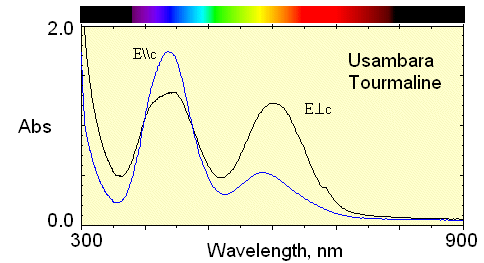
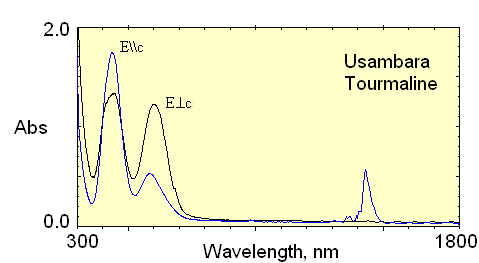
- MT Tourmaline spectrum with the Usambara effect from northeastern Tanzania, (Na0.72 Ca0.25)0.97(Mg3.23
Al5.66
Cr0.12)9.01B3Si5.94O27(OH)4.00, plotted for 1.00 mm thick. Same sample with expanded NIR range spectrum. At the thickness of about 0.2 mm this sample looks like a usual
light-green tourmaline with a distinct dichroism. The Usambara effect
in these tourmalines appears more or less distinctly at thicknesses of
about 2 to 5 mm. To see it, one would decrease the thickness (grind and
polish the sample) until it changes the color from red to green. Data Files: a ; c . Contributed data from Michael Taran, Kiev; Mineralogical Magazine, DOI:
10.1180/minmag.2016.080.016
 Back
to the list of minerals
Back
to the list of minerals
 Back
to the Index of Data Files
Back
to the Index of Data Files
 Back
to the
Mineral Spectroscopy home page
Back
to the
Mineral Spectroscopy home page
last
upgraded 3-Nov-2025
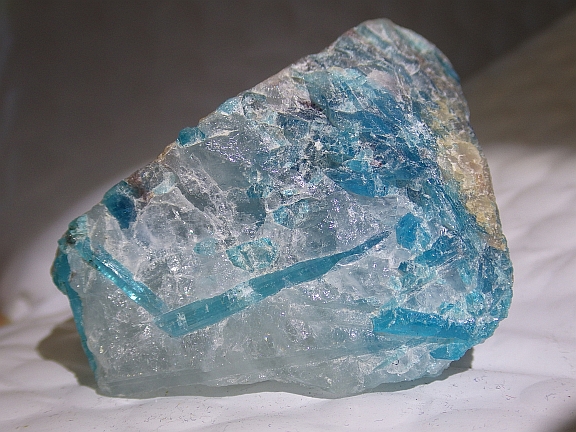





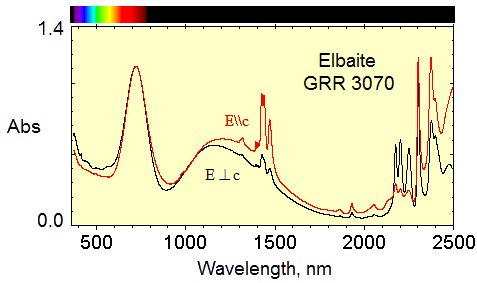
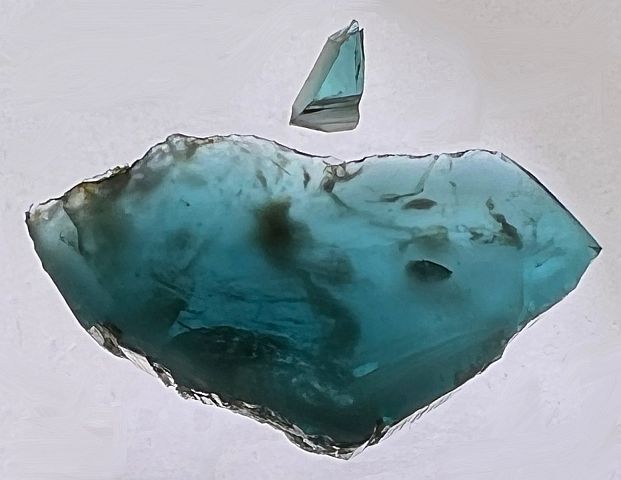 crystal, unknown locality. 2.00 mm thick. Data Files: a ; c .
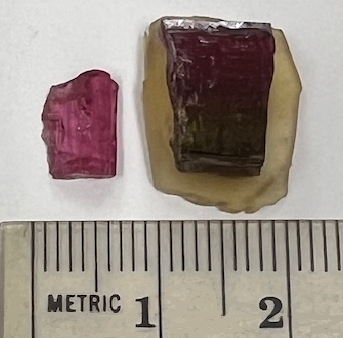 is from Mn3+
and represents one of the deeper colored natural pink tourmalines. Data Files: a ; c .
is from Mn3+
and represents one of the deeper colored natural pink tourmalines. Data Files: a ; c . is natural color from
Mn3+.
is natural color from
Mn3+.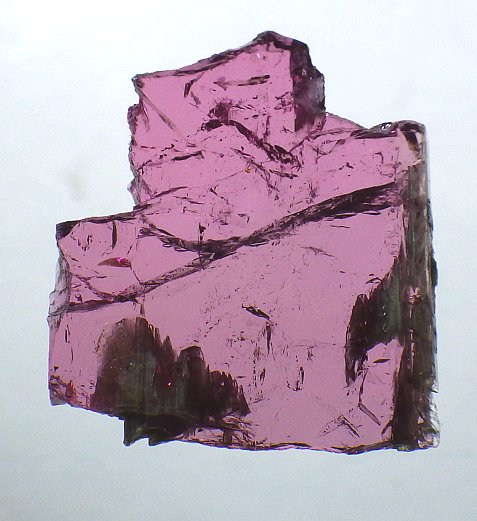 . The color is from Mn3+
and represents a typical treated color for pink tourmalines. While stable at ambient temperatur, the some of the Mn3+ will be converted back to Mn2+ after brief, gentle heating. When heated to the temperature of initial crystallization, esentially all the pink color of Mn3+ is lost.
. The color is from Mn3+
and represents a typical treated color for pink tourmalines. While stable at ambient temperatur, the some of the Mn3+ will be converted back to Mn2+ after brief, gentle heating. When heated to the temperature of initial crystallization, esentially all the pink color of Mn3+ is lost. 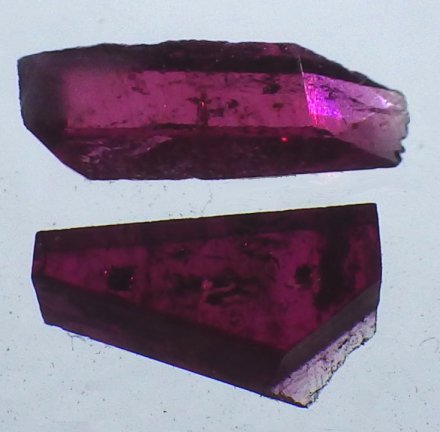 from Khammam, Andhra Pradesh, India. Andreas Ertl provided data on site occupancies: X site = [Na 0.7, Ca 0.0, [] 0.3]
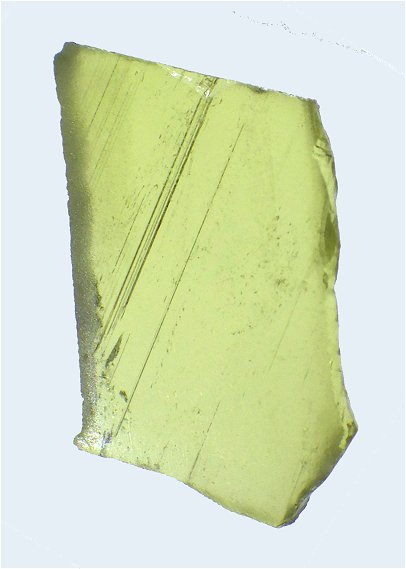 Zambia, 2.00 mm thick, with high Mn2+
content and some Ti4+ that interacts with the Mn2+. Ref: Rossman & Mattson (1986) Amer. Mineral 71,
599-602. Data Files: a
0K ; c 0K ;
Zambia, 2.00 mm thick, with high Mn2+
content and some Ti4+ that interacts with the Mn2+. Ref: Rossman & Mattson (1986) Amer. Mineral 71,
599-602. Data Files: a
0K ; c 0K ;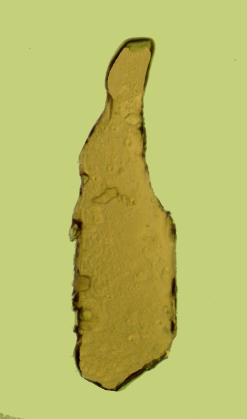 from Narok, Kenya, plotted for 0.10 mm thick. Same sample with expanded NIR range. Composition: Na0.88Ca0.01Mg2.27Fe0.58Mn0.00Ti0.03Al6.12(BO3)3Si5.99O18(OH)4. See: Physics and Chemistry of Minerals 14, 225–234. Data Files: a ; c .
 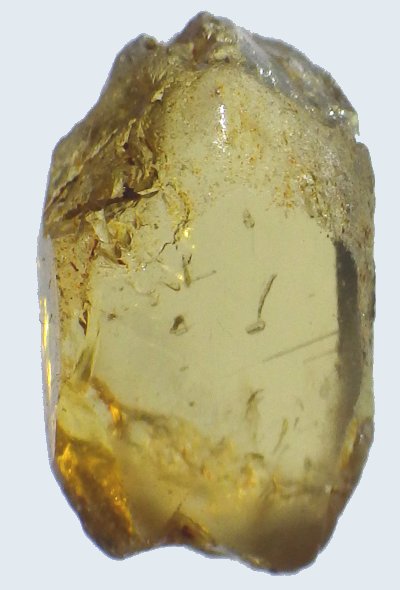 is dominated by an Fe2+-Ti4+ interaction. Data Files: perp c ; c .